

High Performance Xiaolonglin Braiding Machine
Get Latest Price| Min. Order: | 1 |
Share:


 Anhui Hangong Machinery Technology Co., Ltd.
Brand: hangong
The file is encrypted. Please fill in the following information to continue accessing it
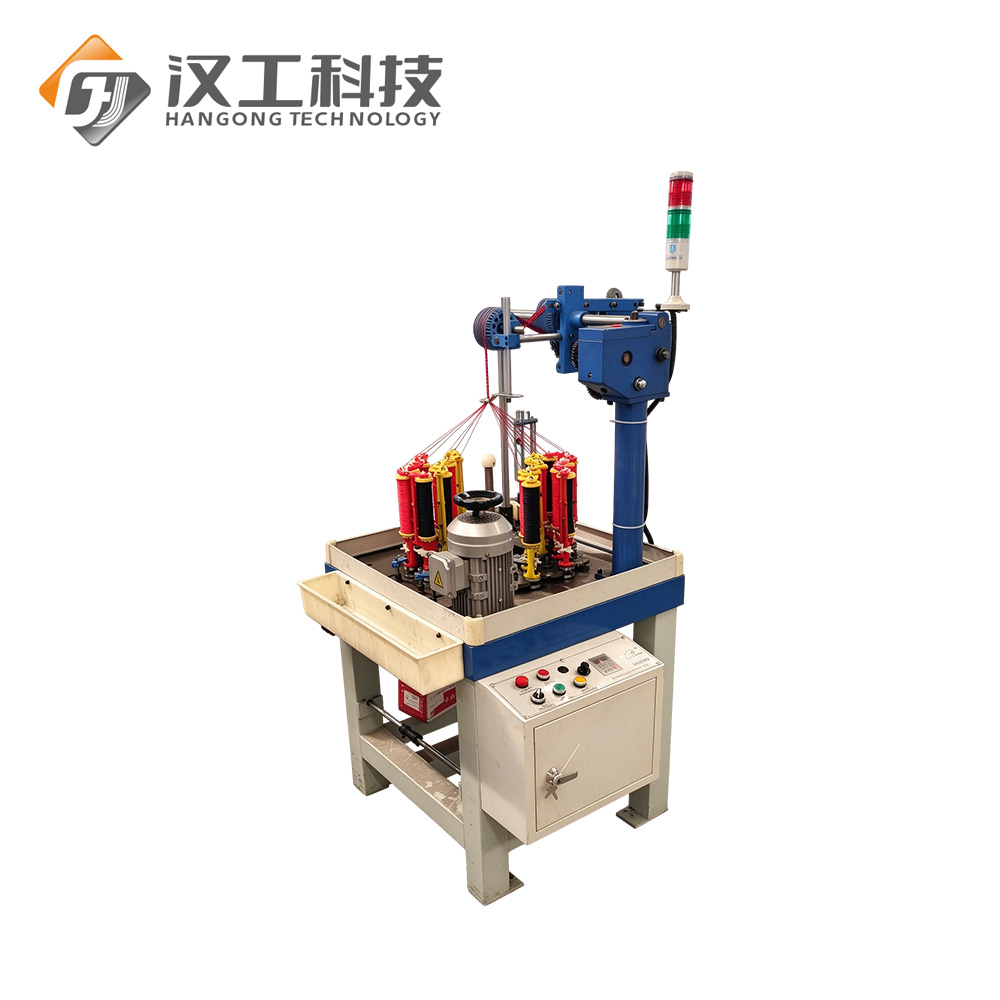
Most braiding machines ask the operator to check the take-up every few minutes. This vertical-frame unit was laid out differently: the carrier deck sits at bench height, the take-up column rises beside it on its own post, and a three-colour stack light on top reports the machine's state from across the room. Start it, set the pull, and walk away. A Xiaolonglin Braid Machine built this way runs a cord from the carrier ring up through the take-up capstan and onto the spool without being touched, which is what makes long, uninterrupted runs realistic for a small operation.
Output per hour means little if the braid is uneven. Running as a High-speed Braiding Machine, the carrier deck turns fast enough for production, while the inverter control lets the operator drop the rpm for fine silk, coated copper or delicate fibre. Tension on each bobbin is set with a spring-loaded carrier rather than a shared weight, so one loose spool does not show up as a thin patch ten metres downstream.
Shielded cable and jewellery wire both demand a cover that stays tight and continuous. Configured as a Xiaolonglin Wire Braider, the machine accepts small spools and keeps the lay length short, giving the dense coverage that electromagnetic shielding and decorative wire both call for. A Wire Tipping Machine in the same family then cuts and fuses the cord ends, so the finished length leaves the workshop ready to terminate rather than waiting on a separate process.
Where the yarn must swing around a core instead of riding a fixed carrier path, the Swing-rod Braiding Machine layout takes over. This is the arrangement used for hollow rope, lanyards and tubular sleeving, where the yarns cross at a shallow angle and the wall stays open. Offered as one of our Xiaolonglin Rope Braiders, it shares the same spindle hardware, so switching between rope and cord work is a matter of reconfiguring carriers rather than buying another frame.
The same drive handles flat work as well. Wider carrier plates turn the unit into a Ribbon Weaving Machine for tape, elastic and narrow webbing, which lets a workshop take on accessory orders without a second machine. Upstream of every braid sits tension preparation, and a Warping Machine used alongside the braider keeps beam tension even before the yarn ever reaches the carrier, which is the least visible but most decisive variable in braid quality.
Leftover yarn and rejected runs are money. The take-up assembly can be run on its own as a Rewinding Machine, pulling a cord or half-used spool back onto a fresh bobbin without engaging the carriers. Setup changes go faster, and partial spools do not end up in a bin. With guarded drives and hardened spindle bearings throughout, this is professional equipment meant to hold alignment through multi-shift work, not a light-duty bench accessory.
Q1: What cord range suits this vertical frame? A1: Typically 1 mm to 6 mm finished diameter; the take-up column and capstan are matched to the range you specify.
Q2: Can it run wire and rope on the same machine? A2: Yes, with carrier and lay-length reconfiguration. We set up the initial configuration for your primary product.
Q3: What support comes with the unit? A3: An operation manual, commissioning guidance by video or on site, and a recommended spares list covering carriers and spindle bearings.


Privacy statement: Your privacy is very important to Us. Our company promises not to disclose your personal information to any external company with out your explicit permission.
Fill in more information so that we can get in touch with you faster
Privacy statement: Your privacy is very important to Us. Our company promises not to disclose your personal information to any external company with out your explicit permission.


 Contact Now