


Please Leave Us A Message
Privacy statement: Your privacy is very important to Us. Our company promises not to disclose your personal information to any external company with out your explicit permission.
 Anhui Hangong Machinery Technology Co., Ltd.
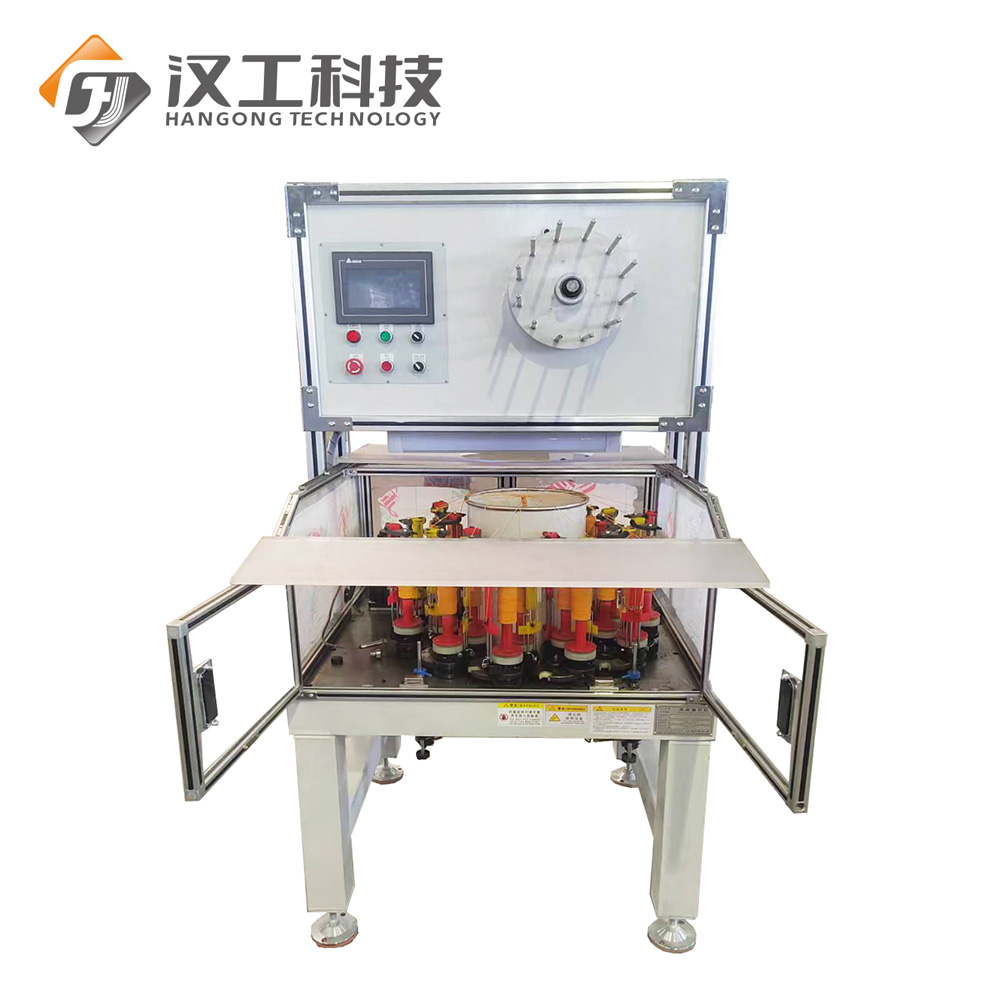
A machine catalogue describes what a braider can do; your product spec describes what it must do — and the second list is the one that matters. Every line on your drawing eliminates or confirms a class of machines before price enters.
| Your product spec | What it decides on the machine |
| Finished diameter | Carrier count band and bobbin size |
| Material (polyester / steel wire / 3K carbon) | Tension control class, speed ceiling, deck type |
| Braid construction (diamond / regular / 2-over-2) | Carrier pairing and gear arrangement |
| Coverage requirement | Ends per carrier, pitch control precision |
| Target output (m per shift) | Carrier speed, take-up configuration, head count |
| Batch variety | Changeover tooling, or multiple smaller decks |
Two enquiries that both say "rope" can land on different machines: one straight 12 mm rope at high volume needs a different deck than nine cord SKUs from 2–10 mm. This is the first trap in any Braiding Machine buying guide for small manufacturers: quoting a machine before listing the SKU mix.
Bottom line: Write the product spec sheet first; the machine requirement list writes itself from it.
Run every drawing through six steps — diameter, material, construction, coverage, output, variety — and compare the quotation line by line. This is the practical core of how to match braiding machine to product specifications,
Step 1 — Diameter to carrier count. Fixed diameter, fixed carrier band: 1–8 mm sits at 12–16 carriers, 2–16 mm at 16–32, rope above 16 mm needs 48+. Top of a band: size up; bottom: size down and save money.
Step 2 — Material to tension class. Polyester and nylon forgive; steel wire and carbon tow do not — fine wire needs carrier tension near 0.5–2.5 N with non-crushing guides. Material decides whether a standard deck is safe or a precision-tension variant.
Step 3 — Construction to carrier pairing. Regular (2-over-2) and diamond (1-over-1) braids use carriers differently, and some constructions unload every second carrier. Confirm the deck supports the pairing, not just the count.
Step 4 — Coverage to ends and pitch. Coverage comes from ends per carrier plus pitch control, not from adding carriers blindly. Ask the supplier to state the ends configuration in the quote.
Step 5 — Output to speed and take-up. The second classic mistake: comparing carrier rpm across quotations as if rpm were output. Output = carrier speed × strands × take-up stability.
Step 6 — Variety to changeover cost. Count monthly diameter or material changes. High variety argues for two smaller decks or quick-change tooling; single-SKU volume for one large deck.
A quotation that cannot answer steps 1–6 in writing is a price, not a proposal. Hangong returns all six as standard — as an OEM/ODM manufacturer with 22 years of experience and 18 patents, it builds to the customer's product, not a catalogue spec.
✅ Bottom line: Six lines on your drawing become six lines in the quotation; what it cannot answer, you are buying as risk.
Carrier speed and product diameter trade against each other, and usable combinations form a narrow band — plan output inside that band, not from a catalogue headline number. The braiding machine speed rpm vs product diameter chart below reflects production combinations at Hangong: as core diameter grows, practical carrier speed falls.
| Product diameter | Practical carrier speed | Typical deck | Notes |
| 1–4 mm (laces, cords) | 200–300 rpm | QX90-class small deck | Small bobbins, high rpm |
| 4–10 mm (round rope, pet leads) | 150–220 rpm | 16–24 carrier deck | Workhorse band |
| 10–16 mm (industrial rope) | 100–160 rpm | 24–32 carrier deck | Bobbin size matters |
| 16–30 mm (heavy, marine rope) | 60–100 rpm | 48+ carrier deck | Reversal shock limits speed |
| 30 mm+ / wire-reinforced | 30–60 rpm | Large or rotary deck | Tension is the constraint |
Two consequences follow:
Downstream, a Rewinding Machine transfers finished braid at matched tension, keeping the braider braiding instead of waiting.
✅ Bottom line: Plan shift output from the diameter-speed band, then add heads or decks — never overclock one machine past its stable range.
Buy for the next 18 months of confirmed orders, not a five-year plan. Cash preservation beats capacity: an idle large deck depreciates faster than a small one earns. Any honest braiding machine buying guide for small manufacturers puts this path first:
One boundary: flat webbing is woven, not braided — that capacity belongs on a Ribbon Weaving Machine, and no braider covers it.
✅ Bottom line: Buy for confirmed orders, expand by product band, automate last — in that order.
Q: Can I match a machine to my product without engineering drawings? A: Yes — a sample plus diameter, material, and monthly volume is enough for a first proposal. The six-step translation runs on those numbers.
Q: Is a higher-rpm machine always the better investment? A: No. Check the braiding machine speed rpm vs product diameter chart against your SKUs: above roughly 16 mm, tension stability and bobbin capacity limit output long before rpm does — headline speed on thick rope is wasted money.
Q: We run five products on one machine — is that too many? A: Not if they share a diameter band and material class. The rule: one deck per band, not one per product — five SKUs in a 2–10 mm polyester band run happily on one 24-carrier deck with quick-change tooling.
Email your spec sheet — or a sample plus four numbers: diameter, material, coverage, target output — and the Hangong engineering team returns a six-line machine proposal within 48 hours, free. Trial braids on your own yarn are filmed before you order. As a China-based manufacturer exporting worldwide, Hangong supports factory-direct pricing, OEM/ODM customization, and lifetime spare-part supply.
Telephone:+86 13705210657
Website:www.ahhgmachinery.com
Email to this supplier
Privacy statement: Your privacy is very important to Us. Our company promises not to disclose your personal information to any external company with out your explicit permission.
Fill in more information so that we can get in touch with you faster
Privacy statement: Your privacy is very important to Us. Our company promises not to disclose your personal information to any external company with out your explicit permission.