


Please Leave Us A Message
Privacy statement: Your privacy is very important to Us. Our company promises not to disclose your personal information to any external company with out your explicit permission.
 Anhui Hangong Machinery Technology Co., Ltd.
The three structures differ in one thing only: the path a carrier travels around the braiding point. Speed, tension consistency, floor space, and price all follow from that path.
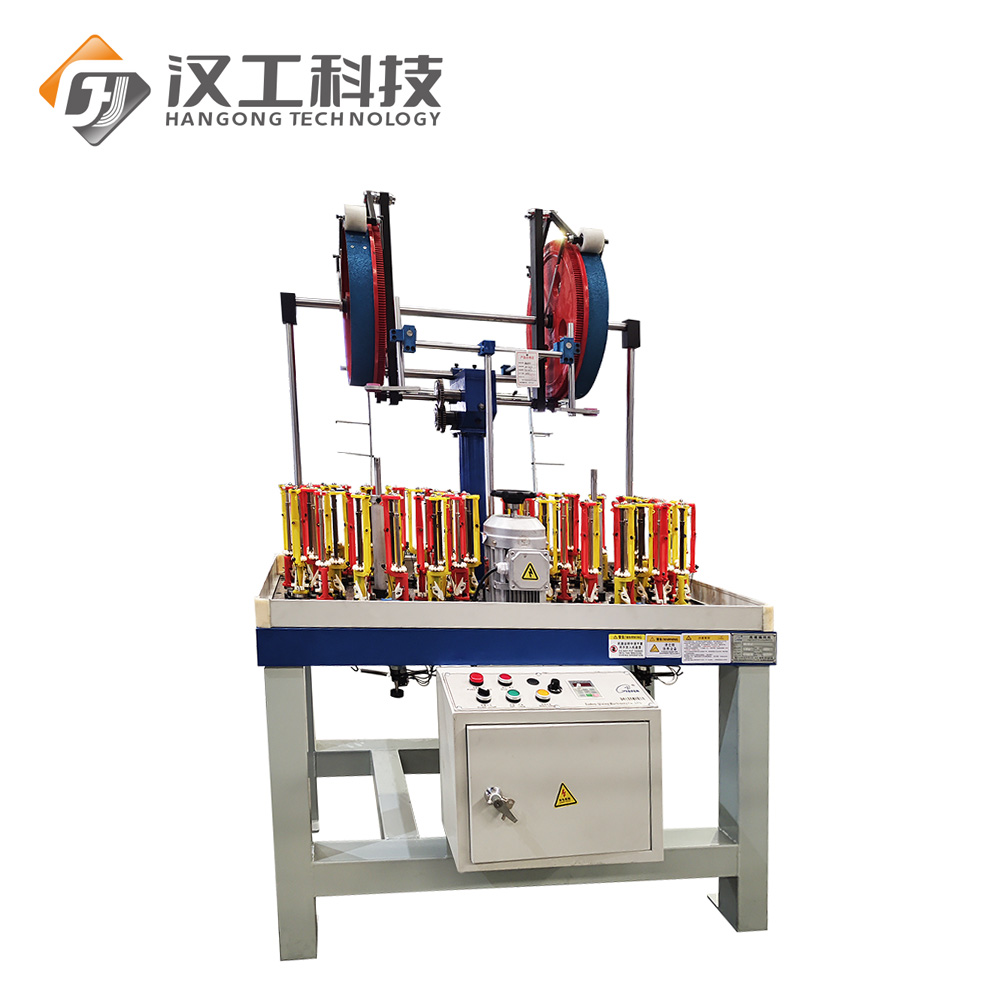
Maypole (horn-gear) deck. Two interlocking rows of horn gears drive carriers in a closed serpentine loop. Each carrier accelerates and reverses at every gear change, so the yarn path is long and tension pulses at each reversal. The upside is flexibility: 12 to 120 carriers on the same platform, easy conversion between round rope, flat cord, and sleeve, and cheap tooling. This is the layout behind most rope machines, including Hangong's 33.120-16-4 and the heavy 62.500-12.
Rotary deck. Carriers sit on two counter-rotating rotors and each one simply completes a full circle. There is no reversal, so yarn length stays constant, tension stays flat, and carrier speed climbs past 200 rpm. Rotary is the standard for hydraulic hose, wire harness shielding, and cable, where the product is straight and pays off axially.
Track-and-column deck. Carriers run radially inward along a track, then rotate around a column before returning. It is the slowest and most expensive of the three, but it braids over a mandrel and follows changing cross-sections, which is why aerospace and medical preforms use it.
| Criterion | Maypole | Rotary | Track-and-column |
| Carrier range | 12–120 | 16–64 typical | 24–144+ |
| Carrier speed | Moderate, limited by reversal shock | Highest, 200+ rpm | Low |
| Yarn tension | Pulsing at each reversal | Near constant | Constant but long path |
| Best product | Rope, cord, sleeve, multi-diameter runs | Hose, wire, cable, straight profiles | Mandrel preforms, bifurcations, non-round sections |
| Floor space | Large deck | Compact | Largest, plus mandrel handling |
| Changeover | Fast, cheap tooling | Moderate | Slow, part-specific |
| Price band (Hangong) | from ~$2,800 | mid to high | project-quoted |
Bottom line: Pick the carrier path that matches your product shape first — deck geometry, not the price list, determines what you can braid.
If you run one straight profile at high volume, rotary is the best Braiding Machine for high speed production; if your catalogue changes weekly, maypole pays for itself in changeover time.
Run three questions in order:
Two cost realities buyers underestimate:
Hangong builds a third variant that softens the maypole trade-off: a swing-rod carrier drive replacing horn-gear impact with a connecting-rod motion, which cuts vibration and reversing shock. On the 31.QX110-52 platform the same architecture supports spindle speeds up to 48,000 rpm, which is why it is used for fine wire and high-count carbon work rather than thick rope.
Bottom line: Match deck to geometry and batch pattern — rotary for one straight profile at volume, maypole for mixed diameters, track-and-column for shaped preforms.
The deck is only the middle of the line; pay-off tension, take-up control, and yarn preparation decide whether it ever reaches rated speed.
Three integration points matter in every quotation:
One boundary worth stating plainly: flat webbing is not a braided product. If half your catalogue is flat, those runs belong on a Ribbon Weaving Machine, not on any of the three decks above.
As an OEM/ODM manufacturer with 22 years of braiding experience, a 30,000 m² plant, and 18 patents, Hangong quotes deck and line together — carrier count, tension range, take-up, and pitch table in one proposal — so the structure you choose is the structure you can actually run.
Bottom line: Compare quotations on tension range, pitch control, and downstream handling, not on carrier count and price alone.
Q: Can a rotary machine braid rope instead of hose? A: It can braid thin cord, but thick rope is a poor fit. The best braiding machine for high speed production on hose is not automatically right for 12 mm rope: short rotor radius suits fine wire and tow, while thick rope yarn needs the maypole path and larger bobbins.
Q: Is the maypole deck obsolete now that rotary machines are faster? A: No. Speed is only one axis. When buyers weigh maypole vs rotary braiding machine which is better for a plant running twelve rope constructions a month, maypole wins on changeover cost and carrier range long before rpm matters.
Q: How do I choose between track-and-column and a rotary deck for composite work? A: Follow the shape. Cylindrical tubes and shafts braid fastest on rotary; anything that changes section, branches, or needs a mandrel belongs on track-and-column. The track and column braiding machine vs rotary selection rule is geometry first, output second.
Send a product drawing or sample — diameter, material, batch size, and target output — and the Hangong engineering team will return a deck comparison with carrier count, tension range, and line configuration within 48 hours. Trial braids on your own yarn, filmed before you order, are also available. As a China-based manufacturer exporting to dozens of countries, Hangong supports factory-direct pricing, OEM/ODM customization, and lifetime spare-part supply.
Contact Hangong for a free deck-to-product comparison.
Telephone:+86 13705210657
Website:www.ahhgmachinery.com
Email to this supplier
Privacy statement: Your privacy is very important to Us. Our company promises not to disclose your personal information to any external company with out your explicit permission.
Fill in more information so that we can get in touch with you faster
Privacy statement: Your privacy is very important to Us. Our company promises not to disclose your personal information to any external company with out your explicit permission.